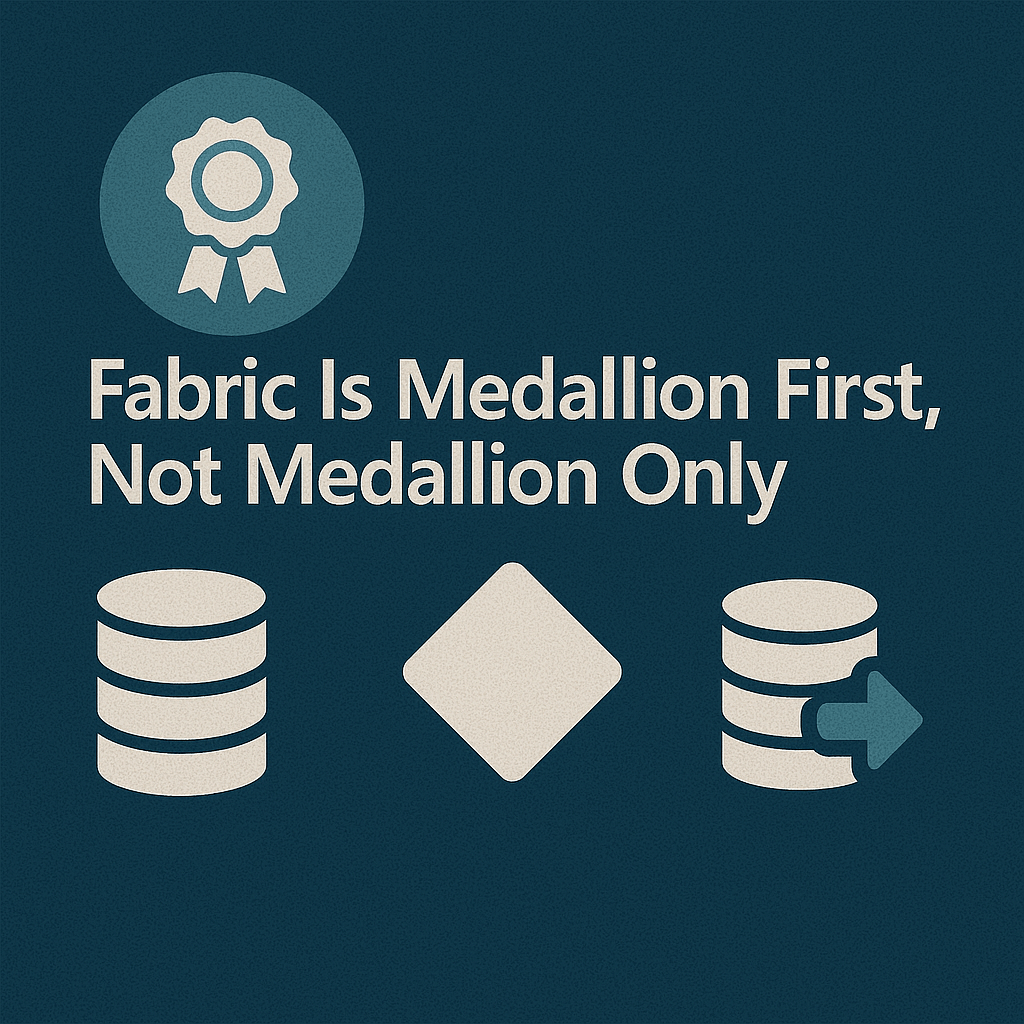
If you work with Microsoft Fabric long enough, it’s easy to come away with the impression that “real” Fabric means “medallion everywhere.” The official docs walk through Bronze, Silver, and Gold patterns for lakehouses. The learning paths lean on medallion as the canonical example. Fabric clearly makes medallion a first‑class citizen.
But that doesn’t mean your data platform – or your data products – must be medallion‑shaped.
In a world of managed, domain‑aligned data products and Data Mesh thinking, what matters most is the contract at the edges: the inputs you accept, the outputs you guarantee, and the behaviors you commit to over time. Inside the boundary of a data product, you have more architectural freedom than many teams allow themselves.
In this post, I’ll walk through three ideas:
Fabric is medallion‑forward, but not medallion‑only. For data products, inputs and outputs matter far more than internal state. Internal architecture should serve engineering excellence, not a single prescriptive pattern – illustrated with small examples from financial services, wealth management, and insurance.
By the end, the goal is simple: when you design a Fabric data product, you should feel comfortable treating medallion as one option in a toolbox, not as a mandatory religion.
Continue reading “Fabric Is Medallion‑First, Not Medallion‑Only”



 EduDataSci - Educating the world about data and leadership